There are four exceptional works of modern art in Northamptonshire churches.
Oundle School Chapel has windows by John Piper (as does Eton College Chapel), All Hallows Wellingborough has an Evie Hone window (ditto) and the other two are both at St Matthew’s in Northampton.

St Matthew’s was built in the last decade of the 19th century. The exterior is of brown stone cut into small regular blocks to look like bricks. The stone spire is 170 feet high. The interior has tall proportions and is faced in white stone giving it a feeling of light and spaciousness. Your eye will be caught by the figure of The Risen Christ suspended (on fishing line) in front of a Victorian wrought iron cross above the Chancel Screen.

“This ethereal figure was fashioned by local artist Malcolm Pollard in 1992 from laminated layers of Jelutong wood, which, like sycamore, is closely and evenly grained and very pale. . . . Although this piece divides opinion and may draw unfavourable comparison with the other art works in the church, it is a triumph of perspective when viewed from the west end and then at the front of the nave. The figure oscillates gently as a result of the air-flows created by the forced-air heating system. This combined with the curvature of the outstretched arms conveys a sense of inclusiveness and welcome to visitors. The nail marks on the figure’s hands and feet may be clearly seen. The halo is of gold leaf.” (St Matthew’s website)
There is a fine, modern (2009) life-size bronze of St Matthew, of course, bur neither are one of the two outstanding works in the church.

Known as the Northampton Madonna and made from Horton stone, Moore’s sculpture is in the North transept, although you are unlikely to miss it. Although there is a Memorial Chapel, 1921, remembering the servicemen of the parish who gave their lives in the Great War and now incorporating those who died in later conflicts, the walls of the church are not cluttered with memorials, an unusual feature allowing appreciation of the building.
Graham Sutherland’s Crucifixion, 1946, in the South transept, is as violent as Moore’s sculpture is peaceful.

Sutherland may have been inspired by an early 16th century altarpiece by Matthias Grünewald, in a museum at Colmar in Alsace.
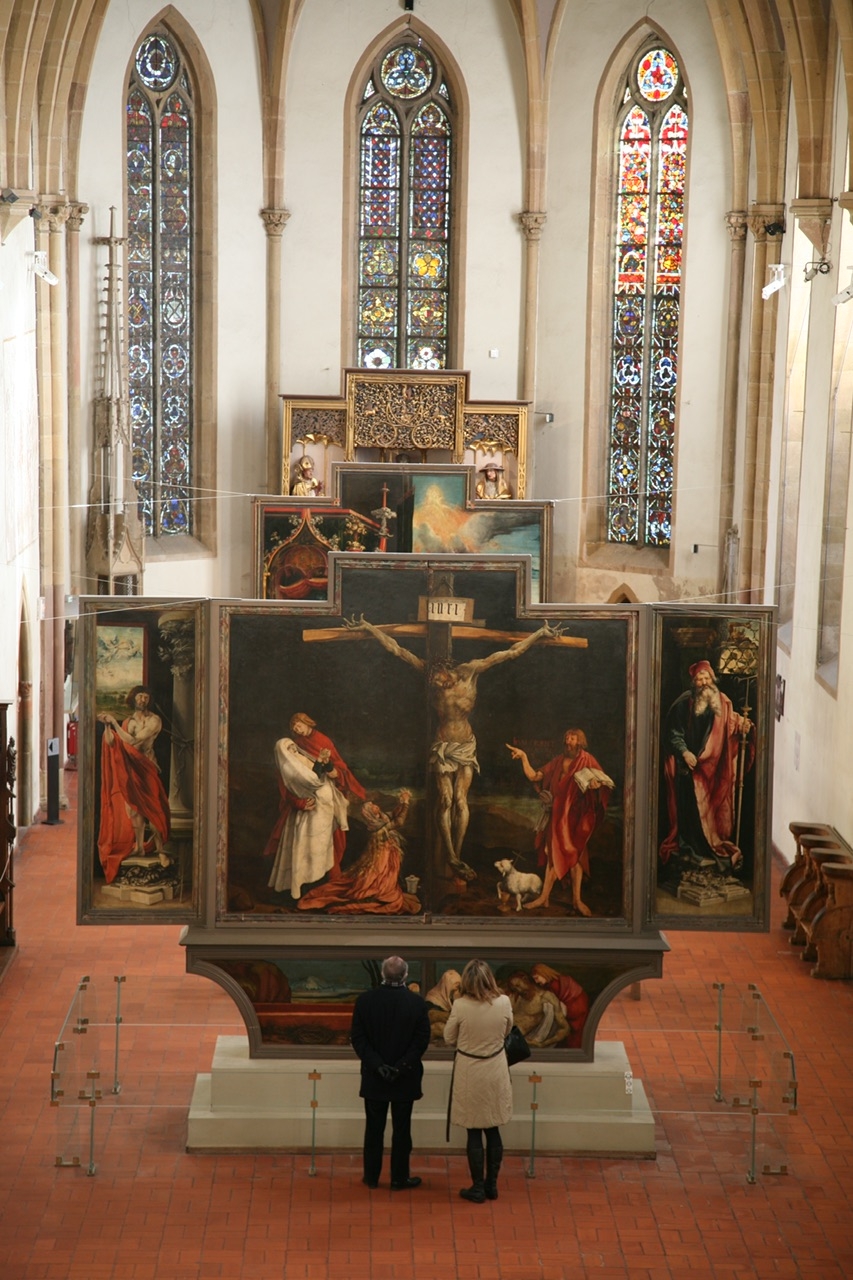
You may wonder how Sutherland’s striking picture came to be here; I did. Chelsea School of Art students and St. Martin’s School of Art were evacuated to Northampton in the war. Sutherland commuted from London to teach and other creative artists like Moore and Britten came too.
(to be continued)
For pale/bleached wood interiors (in this case coupled with Portland stone), I can think of no finer nor more moving example than the modern Abbey Church at Stanbrook Abbey on Wass Bank near Ampleforth. With light pouring in through long west facing fenestration it is truly a breathtaking space of great spirituality.
In my prep school chapel (1965) we had one John Piper memorial window for each of 17 old boys who died in WW2. They were superb – as was (then) the school; it was called Malsis and several years ago met an unhappy but predictable end