“I’m a crime and historical novelist. I’ve written nearly fifty books, three of which have been televised. My awards include the Diamond Dagger of the Crime Writers Association and the Gold Crown of the Historical Writers Association. Who am I?”
CJ Sansom would be an excellent guess but this is Andrew Taylor, Sansom’s successor in his genre. It is good news to find a prolific author that will keep me in reading for many years. I didn’t discover Taylor. The first in the Marwood and Lovett series, set in Restoration England, was given to me by friends who know my literary taste and now I’m off to the races. The first, The Ashes of London, is set during The Fire of London, the second in the aftermath of the fire.

There was commendable zeal to rebuild speedily before the population drifted away and the economy in London shrivelled. As soon as 1666 The Fire of London Disputes Act was passed, establishing a court to settle all differences arising between landlords and tenants of burnt buildings, overseen by judges of the King’s Bench, Court of Common Pleas and Court of Exchequer. This was followed by The Rebuilding of London Act 1666, although it was passed in 1667.
“The act focused on putting straightforward, common-sense building regulations into place as soon as possible. In order to prevent improper construction by over-eager Londoners, the act included a provision to demolish any new buildings that had been erected without adhering to the act’s regulations. Among other things, the act added or modified regulations to architectural styles of buildings on designated High Streets, heights of private homes, building materials (brick and stone preferred), wall thicknesses and street width. The overall effect was meant to be harmonious and orderly, without excessive standardisation.” (Wikipedia) You may think this is an improvement on today’s planning regulations.
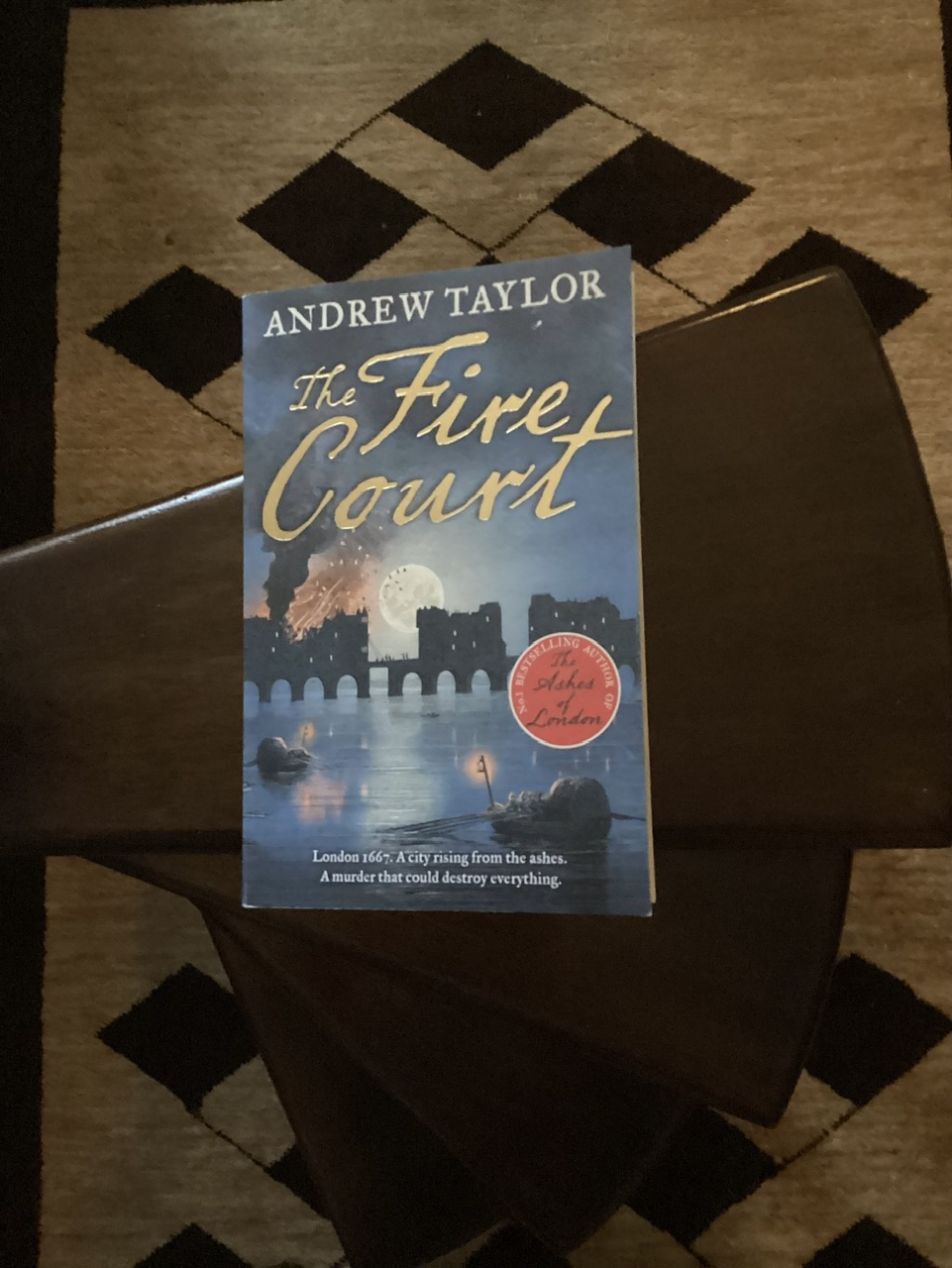
The court adjudicating became known as The Fire Court and this is the focus and title of Taylor’s second novel. There are four more in the series and I am hooked. Incidentally, after the Great Fire of Northampton a similar fast track planning process was set up, learning from London’s example.
I’m afraid Jim Morrison was one of the tragic 27 club. Other names include Janis Joplin, Hendrix, Brian Jones, Curt Cobain, Amy Winehouse and Pete Ham