
The oldest building in Wellingborough is All Hallows, Grade I Listed, dating from 1160. I was in Northamptonshire again this week to see the 20th century windows at All Hallows.
I went to see the Evie Hone but then found there are three by John Piper and one by Jean Barillet.
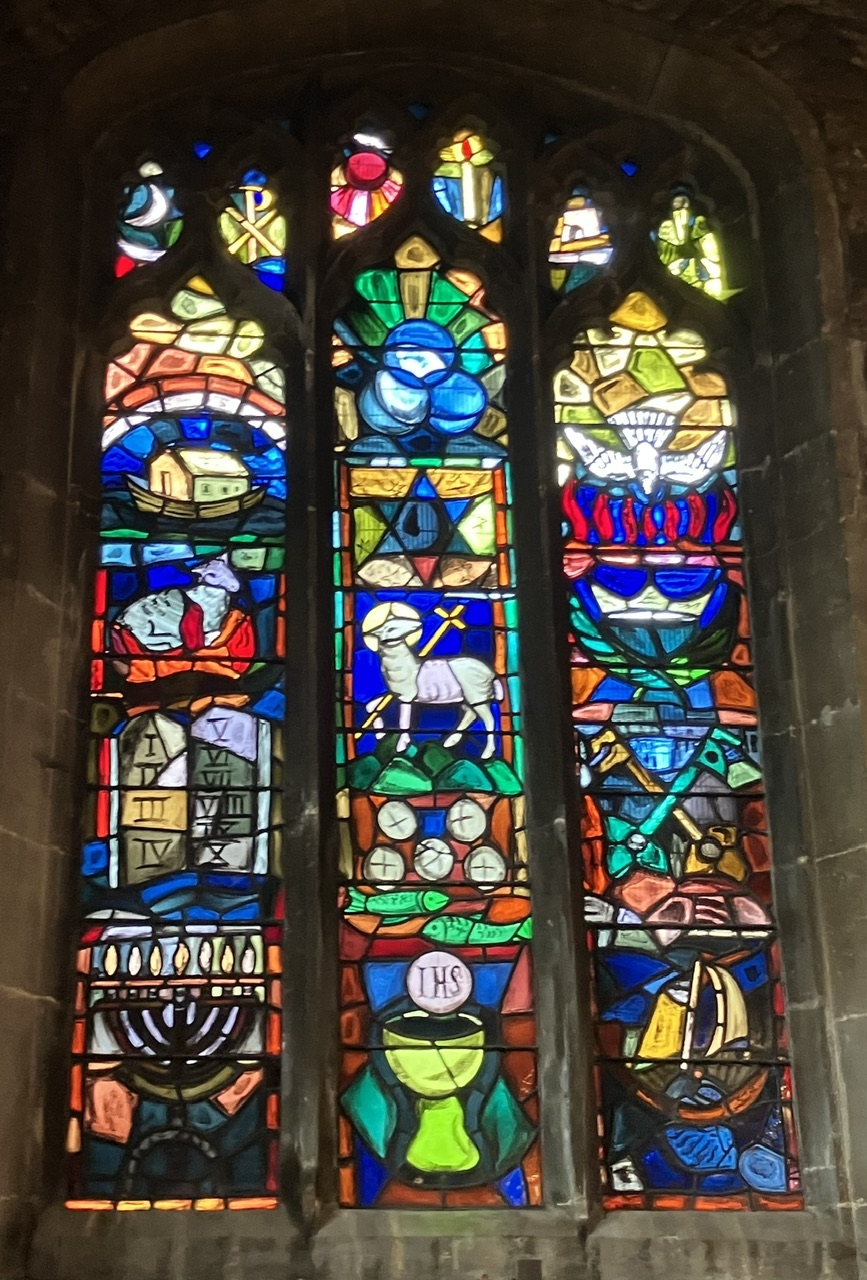
The vivid colours are her trademark but I find the composition cluttered. She depicts events from the Old and New Testaments. Starting at bottom left and moving up there is a seven-branched menorah; the Ten Commandments; a lamb about to be sacrificed by Abraham and Noah’s Ark. Other lights show five loaves, Christ’s chalice, Simon Peter’s miraculous catch, St Peter’s keys, the Virgin Mary and more. Cluttered but the overall effect is pleasing.
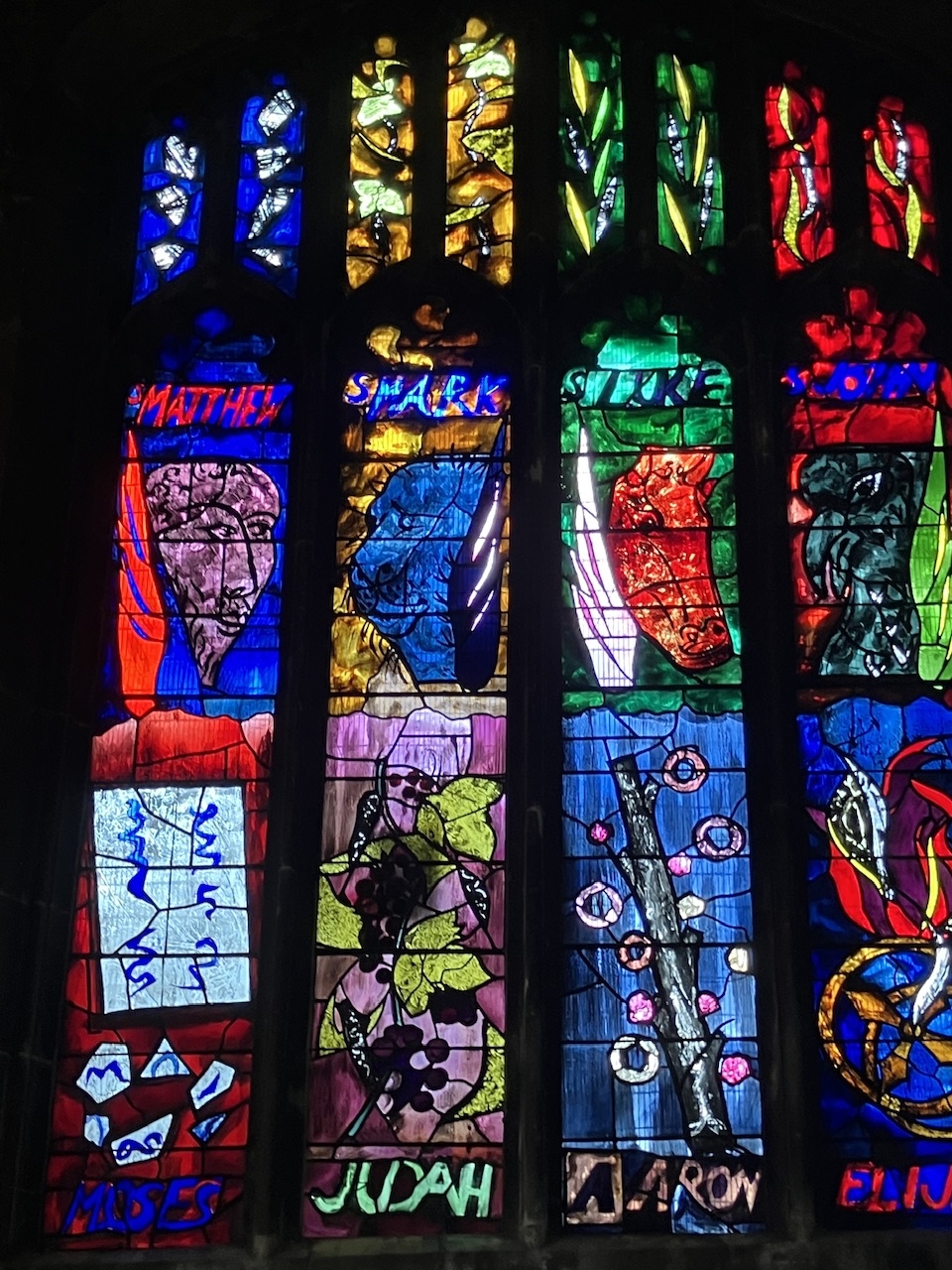
Then there is this window by John Piper. “The window is a four-light window with corresponding tracery above, filled with figurative symbols representing the Four Evangelists and their Old Testament antecedents (Matthew and Moses, Mark and Judah, Luke and Aaron, and John and Elijah).” (Wikipedia)
Piper’s colours are every bit as vivid as Hone’s. I should mention that almost all of Piper’s windows were made in collaboration with Patrick Reyntiens, the former doing the design and the latter executing the work. There is a rose window by them at the west end of All Hallows between the Hone and the Piper you have just seen. Unaccountably I failed to look up and didn’t see it.

The third Piper/Reyntiens window is in the Lady Chapel, commissioned by Millicent Chapman in memory of her sister, Constance. Piper designed the window to evoke her favourite hymn “All Things Bright and Beautiful”. It looks at its best when the sun pours in, something I did not see. Inexplicably Piper neglects my favourite verse. “The rich man in his castle, The poor man at his gate, God made them, high or lowly, And ordered their estate.”

The fourth 20th century masterpiece in stained glass is the Ralph Yorke window by Jean Barillet, a French glass artist. Yorke was a local shoe manufacturer and so the main chapters portrayed are St Crispin and St Crispinian – patron saints of leather workers.

Finally there is this mural by Hans Feibusch showing the Ascension of Christ. He was a prolific ecclesiastical artist and sculptor and I’m ashamed not to have heard of him, specially because his works were bequeathed to the Pallant House Gallery.
“The German émigré artist Hans Feibusch (1898-1998) arrived in Britain in the 1930s. He moved here following persecution from the Nazis and inclusion in the infamous ‘Degenerate Art’ exhibition.
On our shores, Feibusch became a celebrated painter of murals in churches and public buildings, including Chichester Cathedral. In 1997, Pallant House Gallery received the entire contents of his North London studio. The studio formerly belonged to the sculptor Edwin Landseer, and was used by Feibusch for almost 60 years, from his arrival in Britain until 1997.
The Hans Feibusch collection includes around 80 paintings, 50 sculptures, several hundred drawings, studies and copies of all Feibusch’s lithographs (around 50 prints including proof stages). Likewise, the Gallery houses the artist’s sketch books, easels, brushes, props, furniture and books – over 1,700 items in total. We are also lucky enough to add the Hans Feibusch Archive of photographs and ephemera to our collection.” (Pallant House Gallery)
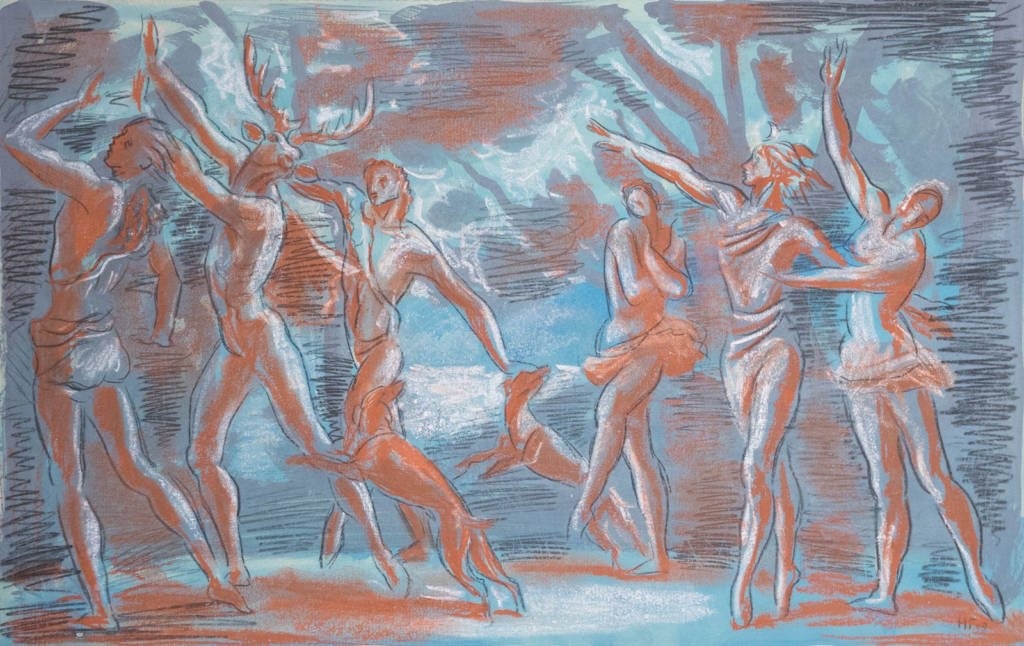
© By Permission of The Werthwhile Foundation.
Don’t imagine All Hallows is only worth visiting for its 20th century glass. There are some very good Victorian windows and 14th century woodcarvings and other memorials. All in all well worth a visit and I was fortunate to be shown round by a local expert.
Your stained glass knowledge is admirable, a missed career in Art History!
The rich man in his castle etc is perhaps referring to the Cooper’s at Markree Castle in co Sligo,it is said