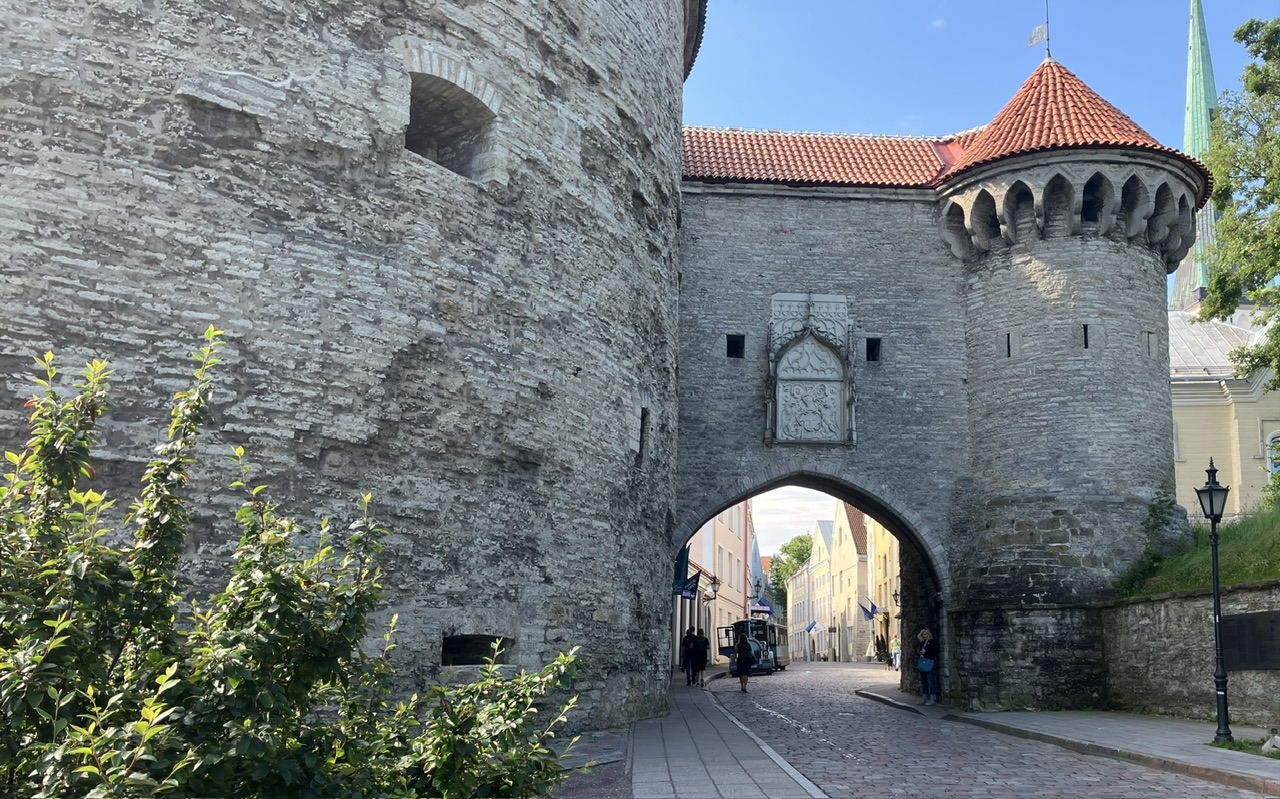
This is The Great Coastal Gate into the walled, medieval centre of Tallinn. Worth noting that at 10.00 am on a sunny, summer morning in July the city is not busy.

First mentioned in 1359, this was the most important of the six gates (of which only two remain), being the main route from the port into the city. The carving above the gateway is Tallinn’s coat of arms and the sturdy tower to the left is colloquially known as Fat Margaret. The tower houses the Estonian Maritime Museum and has a roof-top cafe with fine views. The museum caters more for children and did not hold my attention long. Much better to jump in a Bolt and go down to the Seaplane Harbour where, disappointingly, I did not see a seaplane – I think it must have been being repaired or else I didn’t look hard enough.
The museum is inside a series of huge domed structures used in WW I as hangars for seaplanes. There are lots of exhibits bur it is dominated by a submarine called Lembit.

This was built by Vickers-Armstrong in Barrow-in-Furness in 1934. Lembit and its sister sub, Kalev, arrived in Estonia in 1937 and after crews had been trained to use these state-of-the-art vessels, they were used in a joint exercise with Finland in 1939. When Estonia was occupied by the Soviet Union the subs joined the Soviet fleet – the Twice Red Banner Baltic Fleet. After the war Lembit was used as a training submarine until in 1979 it came back to Tallinn and after some restoration was opened as a floating (sinking?) museum exhibit. It was the world’s oldest submarine afloat until it was lifted out of the water in 2011 to become the exhibit I saw yesterday.

The two nearest guns were designed by a French company in the 1890s. Russia started making them in 1892. They are 152 mm naval guns used on warships and still used for coastal defence in WW II. With a range of twenty kilometres they could fire three rounds per minute. I think they look like prototype Daleks.
On a sad note, there is a memorial to a ferry tragedy in 1994 when the car ferry MS Estonia sank en route from Tallinn to Stockholm. 852 out of 989 lives were lost making it one of the deadliest peacetime sinkings of a European ship, after the Titanic in 1912 and the Empress of Ireland in 1914.
The blue, black, white national flag of Estonia dates from 1884, becoming the national flag in 1918 when Estonia declared independence. It was banned when Estonia became part of the Soviet Union and was reinstated in 1990.

“The blue is said to symbolize the sky, lakes, and sea, as well as faith, loyalty, and devotion. Black represents the traditional Estonian peasant’s coat and the nation’s past struggles. White symbolizes purity, striving for enlightenment, and the snow and birch trees of Estonia.”
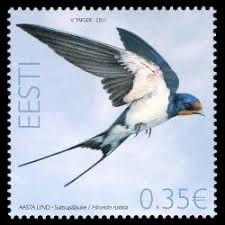
The national bird of Estonia is a barn swallow representing freedom and national pride. I read that somewhere.