
This hotel was constructed for Intourist by Finnish builders in three years in 1972. The usual time was at least ten years in the Soviet Union then.
It was the most modern and luxurious hotel in the USSR, built for foreign tourists to earn much needed foreign currency. About a thousand staff looked after about 800 guests. Yesterday I went up to the top floor, the 23rd floor. It was out of bounds to guests under Soviet occupation. Tourists were told the views posed a security risk. Strangely the views from the 22nd floor did not. It became an open secret that the KGB used the 23rd floor as a listening centre. Some rooms and restaurant tables were bugged and staff were encouraged to report on guests’ activities. It was very sought after to work in the hotel but women had to be married with children to make it less likely they would try to escape by marrying a foreigner, as so many women had married Finnish builders during the hotel’s construction.

The 23rd floor is now a museum exhibiting remnants of the KGB occupation.

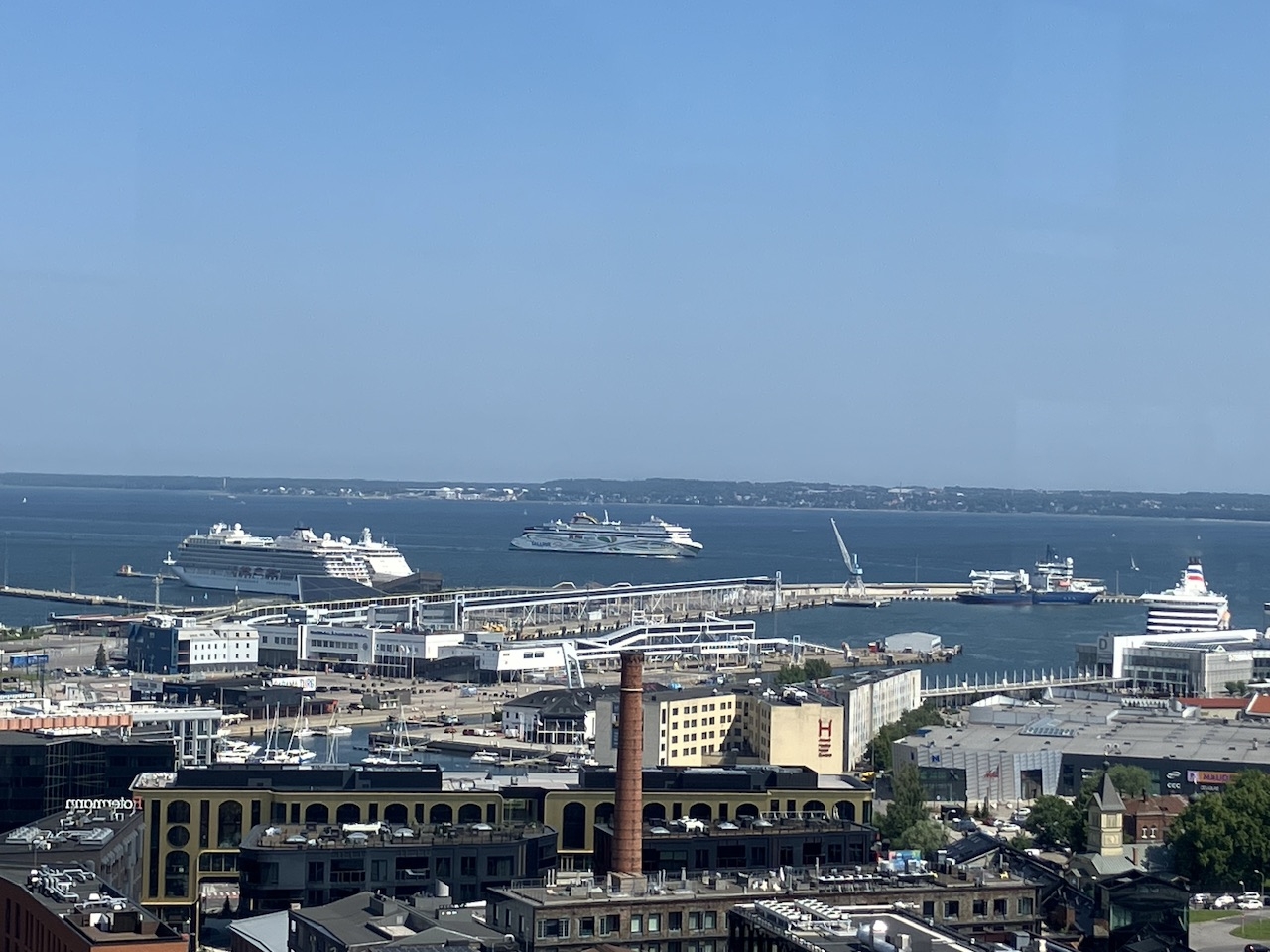
It was an interesting visit because our guide provided stories about her childhood growing up under Soviet occupation. It was forbidden to speak to foreigners. It was forbidden to accept foreign currency and a barman at the hotel who was caught was sent to prison for three years. His crime was actually not to share his money with his bosses and the KGB as everyone else did. A student who was seen talking briefly to a tourist was interrogated for five hours and so on. Anything found lying around had to be handed in unopened. To encourage this the KGB left decoy purses that if opened sprayed paint over the hotel employee – we were shown one of these exploding purses. Oh, and there are super views.
Also outside the walls of the medieval old town is the home of Estonian National Opera, opened in 1913.


The flower market was lovely and there are a lot of fake Irish pubs, as there are all over the world. I was pleased to see three bottles of Jameson on display and had my first sighting of a bottle of Slane Irish whiskey, distilled in the farm buildings at Slane Castle, a few miles away from Barmeath. The distillery was founded by the Conynghams and is now owned by The Brown-Forman Corporation -an American company, still family owned, that makes brands including Jack Daniel’s.

The late Henry Slane, as he was, aged 19, arrived in Johannesburg in a gap year, to join an English company where I was similarly employed. That was c. 1970. He announced himself as “Slane from Co Meath” and had arrived by ship, straight out of Harrow. “On the west coast”, he told us, “we put in overnight and I was entertained by the locals. They gave me wood alcohol, and when I awoke I was blind for five hours”. He married Iona, erstwhile muse of a Yorkshire chum, and affectionately known as the Whale I seem to remember. Enough stories, Ed.