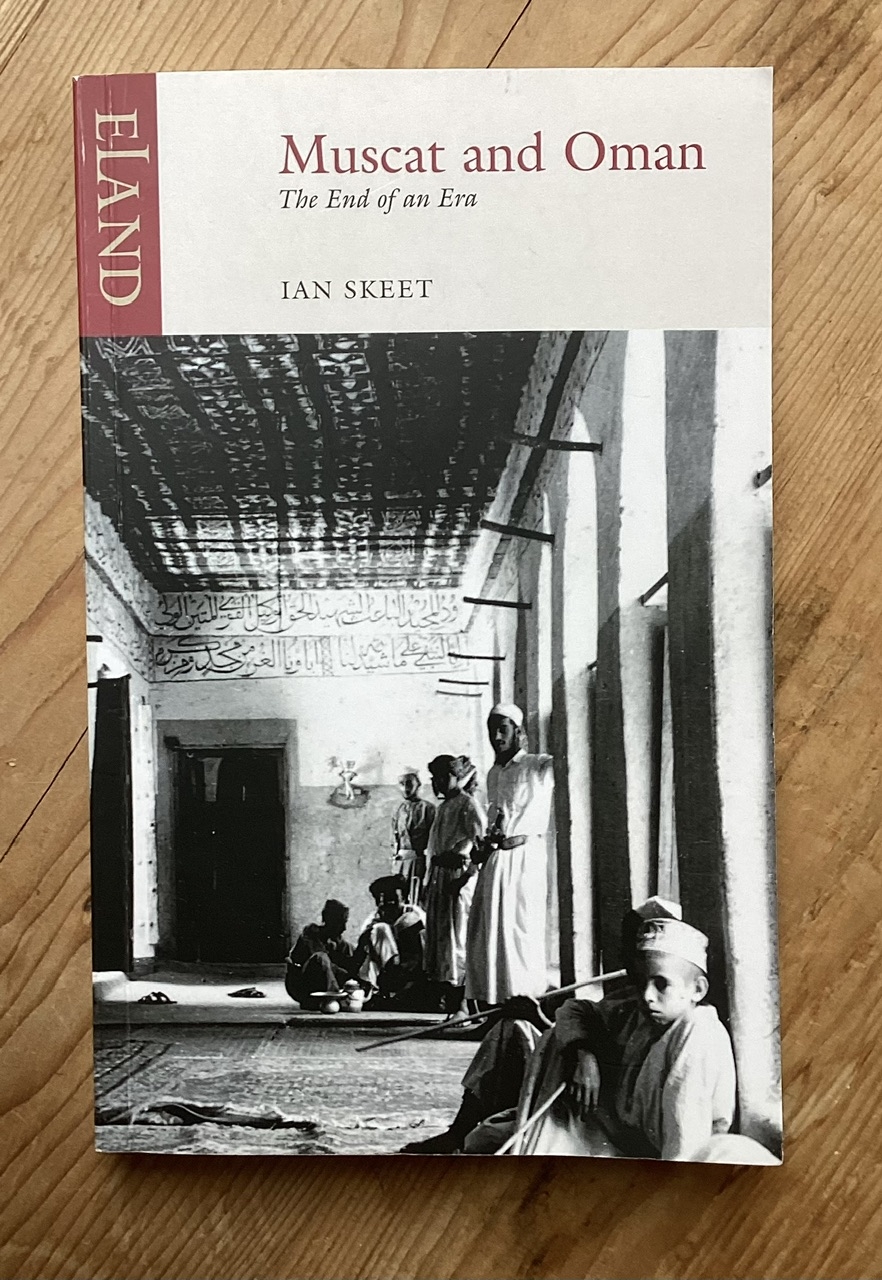
Ian Skeet was in Muscat and Oman from 1966 to 1968 and wrote the first draft of this book a few months after he left. He explains about his book.
“Because of the peculiar attitude of Said bin Taimur to visitors, progress, change, publicity and the many other concepts to which most of the rest of the world has by now become accustomed, there are, as it so happens, comparatively few people who are able to record what Muscat and Oman was like in those days. It seemed to me that this was a record that ought to exist and, primarily because I liked the country and its people enormously, I decided to do the job myself. This, then, is my impression of what Muscat and Oman looked and felt like in what turned out to be the fading years of Said bin Taimur’s reign.” (Muscat and Oman, Ian Skeet)
He was living there less than sixty years ago but the country he describes is medieval. It is fascinating. The book has, for me, one weakness. He has a tendency to digress into the past history of the country going back as far as the Persian occupancy. I got good at skipping these bits. He is reticent about himself and why he is in Muscat and Oman. He died in April this year and his obituary in The Times is as interesting as his book.
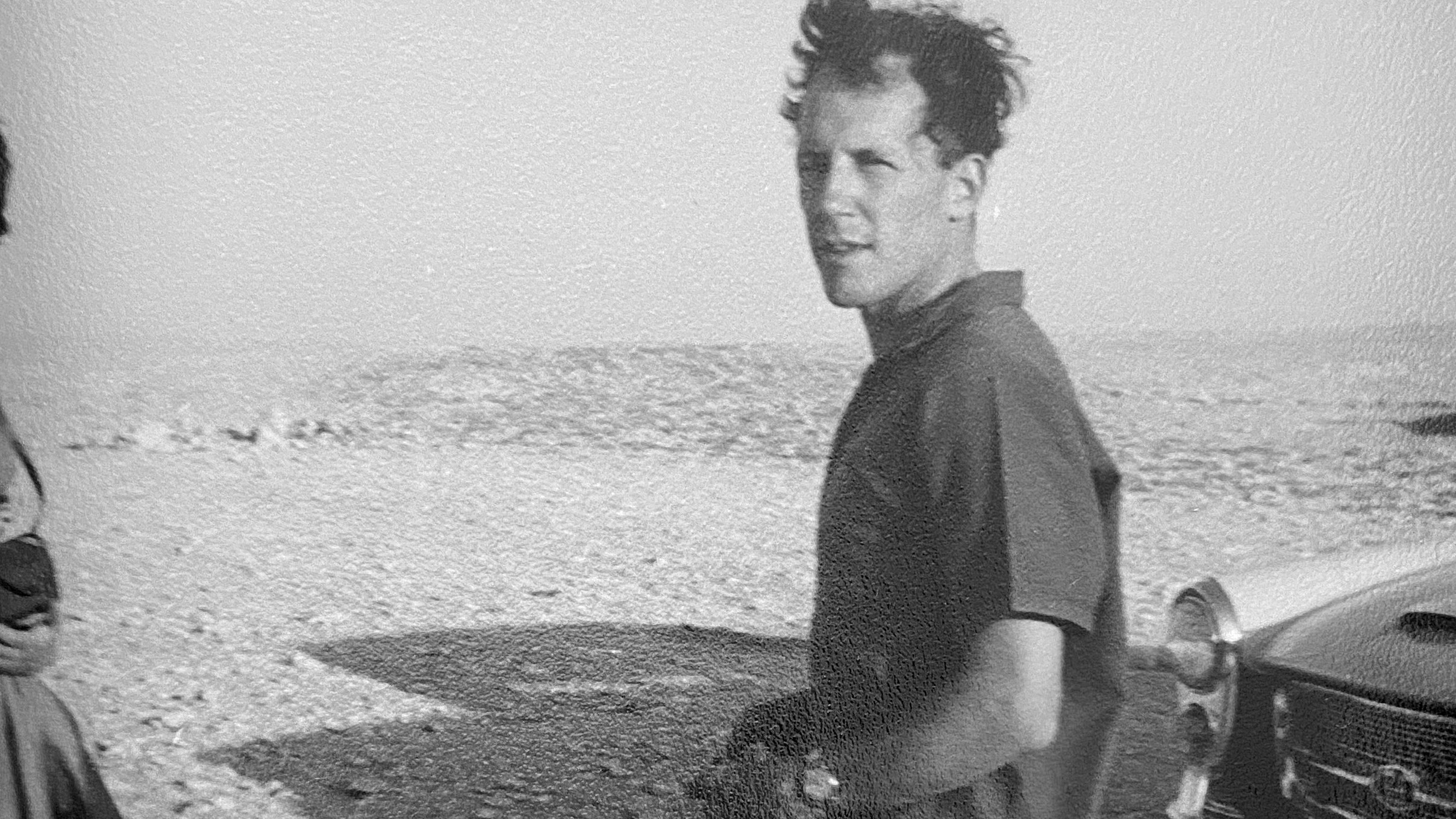
“A humane and broad-minded Arabist who did not remotely fit the stereotype of the modern oil executive, Ian Skeet was one of the few foreigners admitted to the hermit state of Muscat and Oman in the 1960s. He was also one of the few permitted to travel with comparative freedom through large tracts of its interior. Posted there by Royal Dutch Shell in 1966, he made several journeys across the country’s sand deserts and arid highlands with the aim of preparing the wary tribes and sheikhs for the coming of oil.
Since his accession in 1932, Sultan Said bin Taimur had controlled almost everything in the country, personally approving visa applications, deliberately isolating the nation from the headlong development going on elsewhere in the Gulf and shunning the United Nations. But Skeet could see that the sultan’s old ways and days were numbered — he was duly overthrown by his son Qaboos in a British-backed palace coup in 1970 — and that his removal, whenever and however it happened, was bound to precipitate great change.
Feeling that a record ought to exist of what old Oman was like, and with so few other foreign witnesses to hand, Skeet decided to undertake the job himself. His book Muscat and Oman: The End of an Era, published by Faber & Faber in 1974 and reissued last year by Eland, was acclaimed by Jan Morris as “a marvellous work — so learned, so full of insights, and yet often so funny”.
Like Morris — a lifelong friend after they met in Cairo in the 1950s — Skeet was intrepid and slightly eccentric, often wryly amused, and his book is infused with affection, understanding and sardonic good humour.
At a time when neighbouring Dubai was already fast becoming “a booming go-ahead developing place”, as Skeet wrote, Oman’s capital Muscat remained a dusty medieval backwater that still locked its gates three hours after sunset and boasted neither a newspaper nor a wireless station. Inhabitants walking about after dark had to carry a lantern. The Sultan communicated with his people via notices “glued rather inconclusively” to the city gates announcing new laws such as banning the carrying of dolls in public, measures which, as Skeet observed, often hid “a wealth of secondary meaning if you understand the code”. Internal customs barriers prohibitively complicated the conduct of domestic business, not to mention the use of 12 currencies.
The sultan’s motives were in a sense pure, his profound economic conservatism stemming from a horror of foreign debt. But Skeet’s book was a devastating study of the repressive effects of his autocracy, as well as a fascinating portrait of an archaic society on the brink of modernisation.
Ian Peter Hasler Skeet was born in Reading in 1928. His father, CHL Skeet, was a cricketer remembered in his Wisden obituary as “one of the great fieldsmen of his time”, superlative either at cover or in the outfield, and for a notable century that decided the County Championship in Middlesex’s favour in 1920.
He was soon lost to cricket after joining the Sudan political service, however, and was away for much of Ian’s childhood. Ian’s mother Aileen was also away with him for extended periods, including most of the Second World War, when Ian and his younger sister Anne lived with their aunt and uncle. They had earlier begun their education with a governess, who came with them for two winters in Khartoum in 1935-36 and 1936-37, after which Ian was sent to board at Rottingdean, a prep school near Brighton.
He later moved on to Marlborough College, where he played cricket for the first XI and was captain of squash. After National Service in the Army, he took up his place to read mods and greats at Merton College, Oxford, playing cricket for the Occasionals and for Wiltshire.
On graduation in 1953 he joined Shell and after three months of “induction” left London Victoria by boat train to Marseilles, where he boarded a Turkish boat bound for Amman, Jordan, to learn Arabic and more about the oil business. After a further stint at the Foreign Office Arabic school at Shemlan in the hills above Beirut, in June 1955 he was transferred to the PR department of Shell Egypt in Cairo. There he first met James (later Jan) Morris (obituary, November 20, 2020), who was working there for The Times and living with his wife Elizabeth on a houseboat on the Nile.
Skeet stayed on in Cairo after the Morrises left until the Suez crisis in 1956, when he watched with horror and shame for several nights as British bombs exploded on the fringes of the city. Confined to his flat as an enemy alien for a month, he was eventually deported by air in November and later recuperated on a skiing holiday with the Morrises at Samoëns in the French Alps. In 1957 he was posted to Cape Town, where he met his future wife, Elizabeth Pratt, who was visiting from England. They married at Gloucester Cathedral in 1959 and went on to have four children: two sons, Mark and Jeremy, and two daughters, Nicola and Juliet.
After further stints at Shell offices in Qatar, where he looked after the company’s interests across the region, the Hague and London, Skeet was sent to Muscat as management liaison for Petroleum Development Oman, where Shell had recently discovered oil and was in the process of establishing its export. In 1968 he was appointed general manager of Shell Sudan, based in Khartoum, and four years later returned to the job of African regional co-ordinator at the Shell Centre in London. The next year he was appointed head of government and international relations, working under Sir Geoffrey Chandler, where he remained until his retirement in 1985. He later wrote two further books, OPEC: Twenty-five years of prices and politics (1988) and Oman: politics and development (1992), as well as consulting and lecturing.
When Sara Wheeler interviewed Skeet for her biography of Jan Morris, she read Muscat and Oman and was struck by its blend of humour, humanity and serious insightful analysis, which she considered unusual for books of that era. She recommended it to Eland’s publisher Barnaby Rogerson, who was similarly enthusiastic, regarding Skeet’s book as on a par with Morocco That Was (1921) by Walter Burton Harris, whose access to that medieval sultanate had been similarly unique and well used.
Ian Skeet, oil executive and author, was born on November 10, 1928. He died on April 16, 2025, aged 96“
(Obituary, The Times, May 2025)
“4th July, 2025. The Sultan of Oman visited The King at Windsor Castle this afternoon and remained to Tea.” (Court Circular)
Fascinating… thank you.
Ian Skeet wouldn’t recognise Muscat now with its low rise corniche, wonderfully flamboyant mosque, and almost Swiss style of cleanliness. But the people are delightful as they were then in Ian Skeets time. Thank you Christopher for the recommendation.