My next book, well that’s a bit misleading as it will be my first book, is going to look at busts and portraits. I have a newly formed theory that sculptors are more generous than artists. Take a look at these two fellers.


I can hardly believe it is the same man, so perhaps it isn’t but they seem to be. Be that as it may, Bramante had a formative influence on Italian architecture in the first decade of the 16th century, a short period in which the High Renaissance flourished.
“Most art historians state that the High Renaissance started between 1490 and 1500, and ended in 1520 with the death of Raphael, although some say the High Renaissance ended about 1525, or in 1527 with the Sack of Rome by the mutinous army of Charles V, Holy Roman Emperor, or about 1530. The best-known exponents of painting, sculpture, and architecture of the High Renaissance include Leonardo da Vinci, Michelangelo, Raphael, and Bramante.” (Wikipedia)
Two of Bramante’s contributions are the Tempietto del Bramante, visited and written about in 2017, and plans for St Peter’s used by Michelangelo. Bramante’s influence can be seen today throughout Western Europe. English architecture then also had a style not seen anywhere else, Perpendicular Gothic, admired but not an influence today.
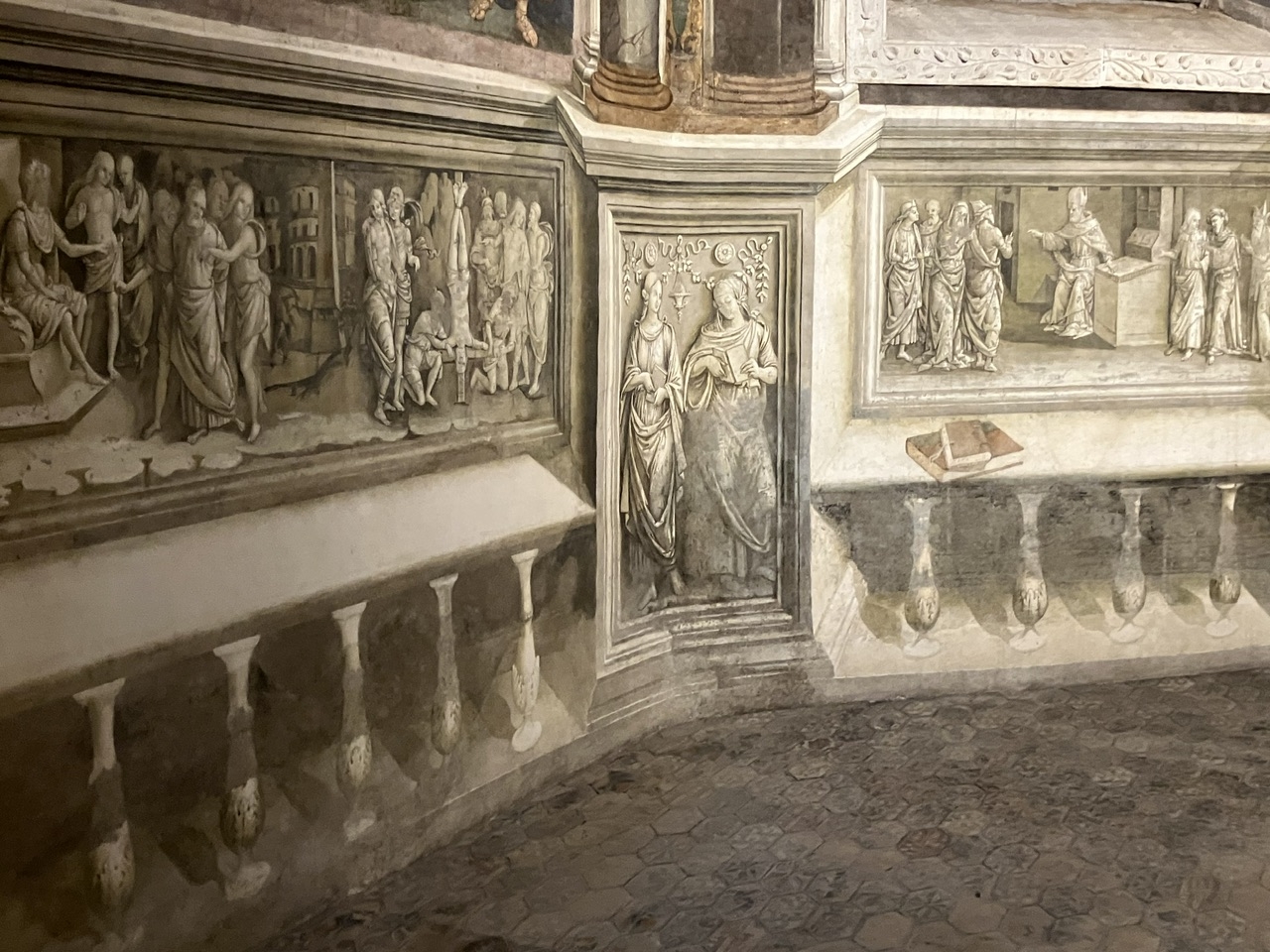
Yesterday morning I sheltered from the rain in Santa Maria del Popolo, dating from the 13th century. It is stuffed with art and sculpture any gallery would be proud to possess: Raphael, Gian Lorenzo Bernini, Caravaggio, Alessandro Algardi, Pinturicchio, Andrea Bregno, Guillaume de Marcillat and Donato Bramante. Perversely, I will show you none of them. I chose this because trompe l’oeil looks more realistic in a photo than real life.
And this because it is the flashiest thing in the church and photographs well to boot.

“The funerary monument of Princess Maria Flaminia Odescalchi Chigi is sometimes dubbed the “last Baroque tomb in Rome”. It is probably the most visually stunning, exuberant and theatrical sepulchral monument in the basilica. It was built in 1772 for the young princess, the first wife of Don Sigismondo Chigi Albani della Rovere, the 4th Prince of Farnese, who died in childbirth at the age of 20. It was designed by Paolo Posi, a Baroque architect who was famous for his ephemeral celebratory architecture, and executed by Agostino Penna.” (Wikipedia)